Authors: Emily Larsen
As part of their mechanical engineering capstone project at Washington State University, students Brexton Lane, Megan Wahlquist, Mikayla Fasoli, Collin Van Wyk, and Emma Smith were tasked by Hanford Tank Waste Operations and Closure (H2C) to develop a safer and more consistent way to clean sampling cables used in nuclear waste tanks at the Hanford Site.
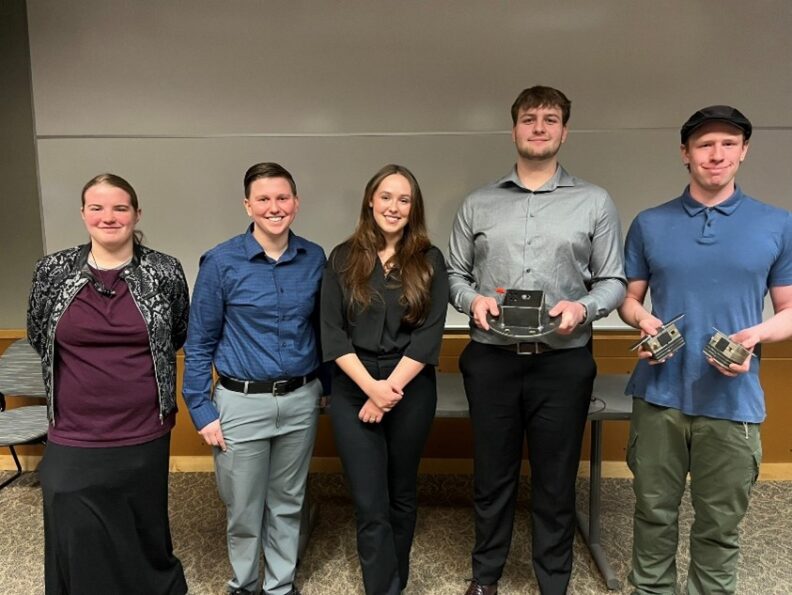
Currently, H2C uses a simple but hands-on method—manually wiping cables inside a glovebag. While effective, the process can be repetitive and physically demanding, especially when wearing layers of protective gear. The student team set out to design a tool that could clean cables more consistently while minimizing handling time.
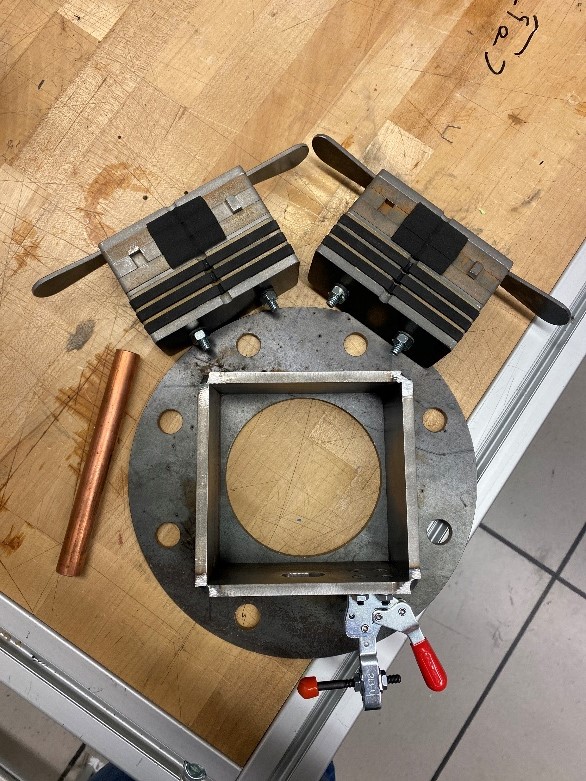
After testing several concepts using sponge and rubber components, the team created a modular cartridge system that clamps around the cable and removes waste as it’s pulled through. Their final design features layered materials cut entirely by waterjet—an intentional design choice that avoids complex machining and makes fabrication simple and scalable.
Demonstrated at the Cold Test Facility in Richland, WA, the device reliably removed over 95% of test contaminants and allowed easy cartridge swaps, even with gloved hands. Washington State University’s team successfully translated H2C’s vision into a practical, well-engineered tool ready for further field testing.